

Until I turned 12, I was educated in the French educational framework, where theatre meant classical French playwrights. Attending a play typically involved productions like The Sound of Music or My Fair Lady. Then, a decision was made that I would switch to an English school. So, at thirteen, I started at Westminster School. It was the late sixties, and my horizons expanded.
I attended a school production of Waiting for Godot in French in a small room with a little stage, and I sat at the rear. In terms of music, I was pretty sophisticated – I was familiar with all the experimental sounds that had been emerging. I’d seen the Mothers of Invention. I’d seen lots and lots. But I was unaware there was stuff like this. I suddenly became aware that, just like in music, there was a whole new world out there.
I don’t know how fluent the French was, but it really didn’t matter what they were saying. It was just so abstract and vibrant, with a sort of pent-up tension. And then, of course, it erupts with the entrance of Pozzo and Lucky. The show was staged by older boys, including Nigel Planer as Lucky. He was a commanding figure on stage. And he must perform that extraordinarily baroque monologue. In French. It was astonishing.
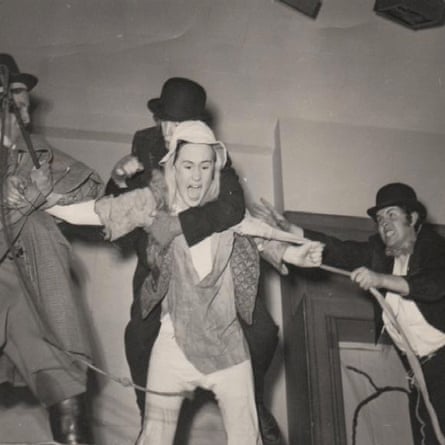
I loved the idea that very little needed to occur, you know? That an event took place and then it continues endlessly and then you have the little boy at the end stating that Godot is not arriving today. It spoke about time and action and plot. Or the lack thereof.
We had been instructed all these guidelines about what drama was, but none of them applied here. I was absolutely fascinated by the minimal action. Years afterward when I was producing music, I would try to turn them into something similar. When a new instrument came in, I’d remove other instruments and intentionally highlight them. So you really heard that keyboard or that guitar or whichever element. That idea of minimalism … I learned that with Godot.
And yet it possesses a narrative. It really does. I mean, they are fully realised characters. They are so alive, the two protagonists, in their mutual affection, like an long-term partners. I can’t say how my life would have evolved if I did not attend that show. To that institution and that play then. It just sparked a realization in me.
We were let out on Saturday afternoons, and I began attending afternoon shows at the Royal Court every time there was a fresh staging. So you would experience works by modern playwrights. But the entry point to all of this was Godot.
I have minimal memory of the performance itself, except I know that it was never boring – it had me at the height of anticipation. What I learned is that there need not be any constraints. It definitely influenced how I worked with the artists that I signed to my label. I even had the musical group write a song around “I Can’t Go On, I’ll Go On”. I just instructed them: “I want a song with that name.”
I think it made me more fearless, too, because you don’t need to worry about setbacks if you embrace Beckett’s worldview.

